
Did You Know?





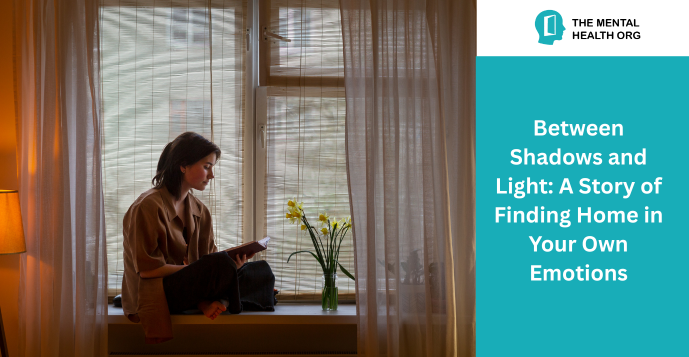
We all live between two worlds—the one we show others and the one we quietly inhabit when no one is watching. That inner world, full of shifting feelings, silent storms, and small sunrises, often becomes the place we run away from the most. But what if that place—messy, overwhelming, uncomfortable—is actually where our real home has been waiting all along?
“Between Shadows and Light: A Story of Finding Home in Your Own Emotions” is a journey of confronting fears, learning the language of your own heart, and accepting the truth that you cannot outrun yourself. It is a story of someone who walked through pain, love, heartbreak, confusion, and hope—and eventually discovered that emotional survival begins with emotional honesty.
This is not a story told in straight lines. It is an emotional landscape—folded, tangled, raw, and real. But it is also a story of becoming whole. Of seeing yourself clearly. Of realizing that you don’t have to fear your feelings anymore.
Every story of self-discovery begins with a moment of collapse. The feeling of I can’t do this anymore. Sometimes it comes after heartbreak. Sometimes it grows slowly until it becomes impossible to ignore. Sometimes it strikes silently at night when the world is asleep but your mind refuses to rest.
The narrator of this emotional journey reaches that point early in the story—overwhelmed by their own mind, terrified of the intensity of their feelings. Anxiety hums inside them like electricity. Sadness sits heavily, like a stone on their chest. Loneliness lives everywhere: in relationships, in friendships, even in a house full of people.
This is where most of us begin—believing that emotions are enemies, believing that strength means silence, believing that pain means failure.
But emotional wisdom doesn’t come from avoidance; it comes from surrender.
And surrender begins with one simple question:
“What am I really feeling?”
For much of the journey, the narrator tries every possible escape route—distraction, denial, overthinking, shutting down, pushing people away. But no matter how far they run, the emotions run faster.
They describe moments like:
feeling disconnected from reality
sensing pressure on the chest that words cannot release
struggling to breathe through panic
hiding behind silence
feeling guilty for not being “strong enough”
craving emotional comfort while fearing vulnerability
This constant tug-of-war creates an internal battlefield.
Every thought becomes a storm.
Every emotion becomes a weight.
Every silence becomes a scream.
And yet, beneath all this intensity, there is a quiet realization growing:
You can’t heal what you refuse to feel.
Even through deep emotional turbulence, there are people who become small beacons of hope.
In the story, someone enters the narrator’s life—a presence warm enough to melt fear, gentle enough to make vulnerability feel less dangerous. Someone who listens, who stays, who doesn’t flinch at the darkness.
This person becomes:
a safe space for emotional honesty
a reminder that softness is not weakness
a mirror reflecting parts of the narrator they have forgotten
a source of calm during overwhelming spirals
But even this deep connection comes with its own complications.
Attachment grows. Hope grows. Fear grows even faster.
Because when you’ve built your entire survival strategy around not needing anyone, finally having someone who feels like home becomes terrifying.
What if they leave?
What if you’re too much?
What if your darkness scares them?
What if your emotions push them away?
These thoughts become storms of their own.
The story shows a painful but universal truth:
Love—whether romantic, platonic or emotional—is not just about connection; it’s about confronting your fear of losing it.
No emotional journey is linear.
Just when things start feeling better, the ground shifts again.
In the story, the once-bright connection begins to fade. Conversations become shorter. Responses slower. Distance heavier.
Silence becomes a whole language of heartbreak.
And the narrator does what many of us do when we sense someone slipping away—we overthink, blame ourselves, replay memories, question everything, try to hold on tighter, and simultaneously begin to pull away to protect ourselves.
This emotional push-and-pull creates inner chaos:
wanting closeness but fearing rejection
wanting answers but fearing the truth
wanting to stay but preparing to leave
wanting love but expecting loss
The emotional intensity reaches its peak when the narrator realizes something devastating:
Sometimes people love you deeply but can’t stay.
And sometimes they stay but can’t love you the way you need.
Accepting this becomes the turning point.
The emotional collapse doesn’t happen suddenly. It is slow, painful, and suffocating. The narrator describes moments of extreme overwhelm—crying without knowing why, shaking from panic, feeling abandoned, losing control over thoughts, struggling with identity and self-worth.
But here’s the hidden truth of emotional transformation:
Every breakdown is a message from your inner self saying:
“It’s time to stop running. Sit. Listen. Feel.”
And so, the narrator finally starts doing exactly that.
This is where the story shifts from emotional chaos to emotional clarity.
For the first time, the narrator stops searching for comfort outside themselves. Instead, they turn inward—toward the fear, toward the loneliness, toward the unprocessed grief. They begin to understand the roots of their emotional storms:
childhood wounds
unexpressed trauma
fear of abandonment
belief that emotions are burdens
guilt for needing comfort
shame for feeling deeply
Slowly, painfully, honestly—they begin to understand:
Your emotions are not your enemies;
they are your teachers.
Sitting with discomfort becomes the doorway to healing.
Healing doesn’t erase pain; it transforms your relationship with it.
The narrator begins to embrace small but powerful truths:
You can miss someone and still move forward.
You can love someone without losing yourself.
You can feel sadness without collapsing.
You can ask for comfort without guilt.
You can be vulnerable without being weak.
You can let go without forgetting.
They start speaking the emotional truths they once hid.
They stop apologizing for their intensity.
They stop shrinking themselves to be “easier.”
They stop abandoning themselves for fear of being abandoned.
They realize:
If you don’t choose yourself, no one else truly can.
Healing becomes a dialogue between shadow and light—an understanding that both are necessary, both are valid, both are parts of being human.
After all the chaos, love, heartbreak, confusion, grief, and growth, the narrator finds the answer they’ve been searching for from the beginning:
Home is not a person.
Home is not a feeling someone else gives you.
Home is the place inside you where all your emotions are allowed to exist.
You become your own safe space.
Your own comfort.
Your own stability.
Your own anchor.
The story ends not with a perfect resolution, but with something more powerful—self-awareness, emotional acceptance, and inner peace.
A quiet knowing that:
You can hold your own darkness.
You can embrace your own light.
You can survive the storms inside you.
You can love without losing yourself.
You can feel deeply and still be strong.
And most importantly:
You can always find your way home—to yourself.
“Between Shadows and Light” is not just a story about heartbreak or healing. It is a story about returning—returning to your emotional truth, your inner voice, your human softness, your own heart.
It teaches us:
that emotions are not weaknesses
that intensity is not something to hide
that vulnerability is courage
that love and loss shape us
that healing is a lifelong practice
that self-awareness is the beginning of peace
Most of all, it teaches us that the journey inward is the most important journey of all.
Because in the end, the only person who stays with you through every emotion—every rise, every fall, every storm, every sunrise—is you.
And when you finally learn to embrace every part of yourself, you discover that the place you’ve been searching for, longing for, aching for…
has always been within you.
To read on our detail article visit: Between Shadows and Light A Story of Finding Home in Your Own Emotions




1 Comment
binance konto skapande
Your point of view caught my eye and was very interesting. Thanks. I have a question for you. https://www.binance.com/register?ref=IHJUI7TF