I kept a journal when I was 13. The remainder of every other page merely bore the word ‘FOCUS’ drawn in all directions, in various forms, in calligraphic ballpoints. I did not recall doing it until I rediscovered that journal at the age of twenty. It was then that I came to realize- my plight was not imaginary, and it had always been that way.
When you have ADHD then you have spent years of your life thinking that you are the problem. Perhaps you have said to yourself, you are lazy, undisciplined or simply not trying hard enough. Perhaps, you have been bearing the burden of a million criticisms, corrections, and disappointed glances. You have possibly sensed that you are masked, that you are acting something you are not in order to be a part of the world which appears to be made of all but you.
But what should I say to you, that you need not end your story with shame? Imagine making your ADHD experience a healing experience by being honest, finding a community to help you, and radical self-acceptance?
The Weight of Invisible Wounds
Being undiagnosed with ADHD as a child is having invisible wounds that you are always hurt by yet everyone can see. By the age when most children with ADHD are 10, they are subjected to some 20,000 or so corrective or negative messages by the time they are 10-20,000 messages telling them that they are doing something wrong or need to make more effort or are too much or too little.
These aren’t just statistics. These are actual experiences that are imprinted in growing hearts and minds. All the sit stills, pay attentions, why can’t you just pay attention? joins an internal dialogue that is murmuring: “Something wrong about you is at the core of you.
The guilt psychological impact in ADHD goes deep. Our dishevelly rooms, our lost engagements, our temper tantrums, our lack of ability to sit in a meeting without fiddling bear our guilt. We are guilty of being unusual in a conformist world.
“Maria, a 29-year-old graphic designer, is one of the people who was diagnosed with ADHD at 27 and has spent her whole childhood apologizing. Sorry I was late, sorry I forgot, sorry I interrupted, sorry I cried when I got hysterical. I was apologetic to the extent that I began to apologize that I apologized. I came to know that the way I naturally was in the world was a wrong one.”
The Crushing Reality of Emotional Discipline
Your natural responses continue to receive the same message over and over about being too much, and you get to learn to put them down. You get used to putting your troubles under a mask of merry face, to conceal your panic under the veil of feigned sanity, to cover your sensitivity with a blanket of I am fine.
The effects of emotional suppression in ADHD are devastating. The further back we repress our feelings, the more they become strong. The better we conceal our predicaments the more we are alone. The further away we become the more we pass as being normal.
This repression finds outlet in the following manner:
– Unrecognized emotional anguish manifested as unaccountable sadness or numbness.
– Harm inflicted by deceiving ourselves and other people concerning our experiences.
– The stress of secrets to which the mind and mind strain–the burdensome labor of maintaining appearances.
– Being guilty even when we have done nothing as the shame has become our new state of bein
“James is a teacher aged 35 and says that he had been so skilled at concealing his ADHD that he forgot he was doing it. I believed that everybody had troubles just like I did. I believed that all people always have noise in their heads, that all people forget conversations minutes after communicating with each other, that all people feel like they are overwhelmed by simple things. When I ultimately received a diagnosis, I mourned over the fact that I spent many years of my life thinking I am broken as a kid.”
The Breaking Point: When the Mask Can’t Hold
There comes a time when the repression of emotions becomes overwhelming to many of us. When the weight of untold truth is more than the fear of being vulnerable. This is what tends to be a breakdown but it is in reality a breakthrough, the starting point of your trip to authenticity and recovery.
Such breaking points may appear in different ways to all:
– The panic attack on a regular day in the middle of it.
– Failure to move out of bed having no justification as to why he should be depressed.
– The time when it is impossible to handle simple matters of life.
– The discovery that you are acting your whole life.
“The story of Laura, who had what she considered to be a nervous breakdown in her childhood bedroom, is familiar to so many adults with ADHD. I was going through old journals, and I came across pages on which I could read the word focus repeatedly written. I do not recall writing it, yet seeing it put the whole thing together. It was all worth it, all the years of struggling, making so much of myself what everyone wanted me to be. I wept hours, not to be what I was in the present, but to be the little girl who was struggling so desperately to be accepted.”
The Liberation of Truth-Telling
Naming what we experience is such a healing process, and there is something so healing about uttering our truth aloud. The process of healing starts the moment we quit faking that our struggles are not actual, understating our pain, apologizing that we are different.
This telling of the truth may begin with:
– Realizing that you are not alone in your struggles, even when other people do not understand them.
– Understanding that your ADHD is not a personality vice or a personal weakness.
– Learning to realize that your sensitivity and intensity is a gift not a burden.
– Learning to accept that you are entitled to be supported, accommodated, and show compassion.
Discussion of trauma is a vital step towards healing, as well as the trauma of being neurodivergent in a neurotypical world. It may include the engagement of a therapist who is aware of ADHD, a mental health support group, or just talking to trusted friends and relatives in a straight forward manner.
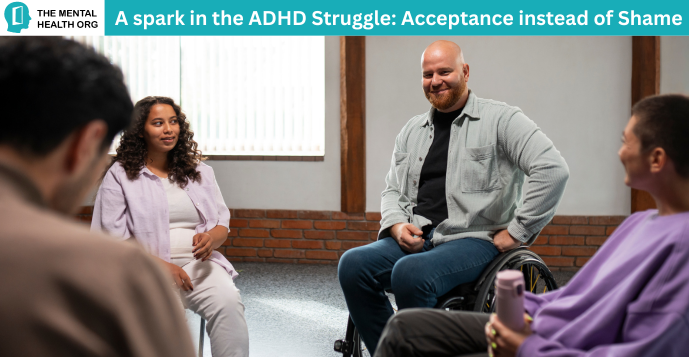
Finding Your Tribe: Community Reality
It appears that one of the most therapeutic ones that people with ADHD find out is that they are not the only ones. Community ADHD awareness presents a component that we, most likely, have never been exposed to, namely belonging.
Along with ADHD awareness communities, online mental illness communities are the ones where you will find a person who understands why you are so hyper-focused on creative projects, have spent eight hours straight working on one of them, and have forgotten to eat lunch. Those who know that criticism is harmful to them as a physical pain. Those who celebrate your well being and give you a little air in your misfortunes.
“David is a 31-year-old author who informs him that he has really rescued his life when he searched his ADHD community online. It was the first occasion that I met people who could understand why I could write 10,000 words paper within a sitting and could not reply to a text message. I found that there existed people who knew how it felt to be either an excess or a lack of something on some people. I found my people.”
These communities offer:
– Peer support of ADHD by individuals who can relate what it is like.
– Anonymous mental health chat in case you need to be helped and you are not ready to be totally vulnerable.
– Guilt healing circles helping you in the years of cumulative shame.
– Write about your mental health experience where it can be applied by others.
Re-Writing Your Story: Problem to Person
The process of overcoming the emotional trauma of ADHD involves a process of rewriting your story of who you are. Instead of thinking about yourself as being broken or lazy or defective, you can begin to consider yourself as:
– Neurodivergent: You have a different brain, but it does not work wrong, it just works differently.
– Tender hearted: So much human You tender hearted are.
– Innovative: Your ADHD brain does not think like other people.
– Strong: You are a survivor and you have been able to cope with a lot of it.
– Important: Your opinion and experiences are valuable.
The process may include the use of mental health journaling as a useful tool. Write letters to the younger self. Write in your miseries and in your merits. Educate yourself on indicators of suppressed emotional distress and celebrate small achievements in your process of recovery.
The Process Continued: Learning to Be Soft on yourself
It is not a healing place, but a self-compassion, advocacy and acceptance process. Other days will turn out to be tougher than other ones. On certain days, your inner voice of goodness will not be as powerful as the old voices of shame. That’s normal and expected.
The self-healing process is also through writing of which this is particularly important. Write about yourself, and about your experiences, fears, hopes. Write emails, which you will never have the opportunity to send to people, who have never understood you. Write love letters to the ones that you have conditioned to hate in you.
Remember:
– This is also alright even when other people fail to understand how you feel.
– The sufferings are there, though invisible.
– It is a blessing even at a time when the world is attempting to turn your differences into a problem.
– And you have something to say even when you feel that no one is listening.
– You should be loved and be belonging to something, just as you are.
Making a Life Your ADHD Brain Loves
It is also something that you will begin to lead a life that is in sync with your ADHD brain, which does not go against it as you get better. This might involve:
– Years of negative messages internalization is transferred to guilt and shame processing therapy.
– Learning how to express your emotions safely and this is through understanding the impacts of holding your emotions.
– Making mental fatigue solutions of ADHD that actually work in your mind.
– Finding a job, love and locations that enslave you.
– Creating support systems that are familiar and able to fit you.
“I could not bounce back and become normal, and that is why I consider the concept as Sarah who is an entrepreneur at the age of 38. It had to do with the opportunity to be my real self. It was about the respect of my ADHD brain instead of the difficulty to overcome it. It was encircling myself with people that viewed my sensitivity as superpower and not a weakness.”
To Your Story It Is Still Being Written To.
Should you be reading this and come to the discovery that you are the one of these words, your story is not finished as yet. The shame and struggle and suppression chapters should not have to define the rest of your book. You are able to make your own books of self acceptance, community, real relationships and true happiness.
And it is not a mistake, like your ADHD brain, with all its intensity, creativity and beautiful complexity. You aren’t a mistake. You are everything you are supposed to be, and the world ought to be in a position to receive what you can offer.
The process of leaving the state of shame behind the stage of self-acceptance is not always unproblematic, but it will definitely be worth it. You deserve to live an authentic life, you deserve to be loved the way you are and you deserve to be at peace with your beautiful neurodivergent mind.
Your healing matters. Your story matters. You matter.
And you are, quite, quite, quite, quite enough.










2 Comments
създаване на профил в binance
Your article helped me a lot, is there any more related content? Thanks!
thementalhealthorg
yes, there is a lot coming in queue.